
West Virginia Has the Power – Now it Needs the Wires
April 7, 2026
By Craig Blair, Executive Director of West Virginians For Reliable & Affordable Energy,
Former Senate President – Lieutenant Governor

How transmission will decide the future of West Virginia’s economy
West Virginia stands at an energy crossroads and the decision about whether to modernize its transmission grid will shape the state’s economic future for decades.
Demand for electricity is exploding nationwide, “adding 15 New York Cities” worth of new power demand by the end of the decade, as grid expert Rob Gramlich, president of Grid Strategies, put it in a recent West Virginia Chamber of Commerce webinar, “Powering the Grid: Understanding Transmission.” At the same time, the cost of connecting new generation to an outdated grid has already increased eightfold. For business leaders, this isn’t an abstract infrastructure debate. It’s a question about whether West Virginia will have the affordable, reliable power that manufacturers, data centers, and employers of every kind require to locate and grow here.
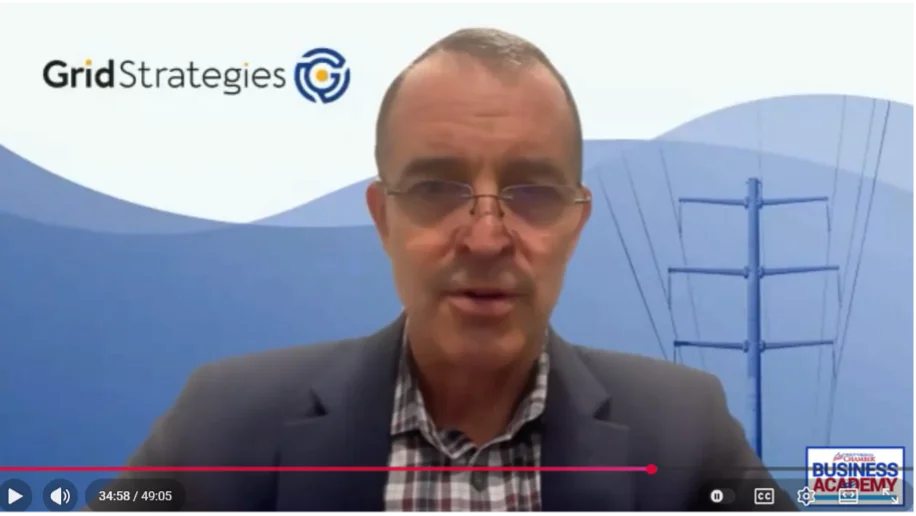
Grid Strategies President Rob Gramlich addresses the need for modern, reliable transmission that will decide West Virginia’s economic future.
The good news is that the investment math is compelling: Gramlich told webinar attendees that a well-planned grid buildout has a minimal per-month cost to customers – think like a cup of coffee – while unleashing a multiplier amount in efficiencies on the grid. The question isn’t whether West Virginia can afford to modernize its grid. It’s whether the state can afford not to.
You can hear what’s at stake for West Virginia’s economic future from the webinar here; below are highlights, in this Q&A led by Brian Dayton of the West Virginia Chamber with Rob Gramlich and Zach Zimmerman of Grid Strategies.
Gramlich had opening remarks:
Demand is Increasing and an Outdated Grid Can’t Keep Up
- Power demand is growing. We keep using electricity for more and more things.
- The new demand on the system is like we’re adding 15 New York Cities by the end of the decade.
- The grid is old; many assets are 50 to 70 years old and need to be replaced. At the same time, demand is increasing, supply is tight, severe weather is costly, and equipment is expensive.
Immediate Benefits with Costs Spread Out Over Time
- [With an upgraded grid] you can really get an immediate improvement in the ability to connect new load generation, which is great for economic development.
- The benefits can be immediate, reducing congestion, giving access to low-cost generation, and improving the ability to connect new load or generation, which is important for economic development.
- There are costs [for an upgraded grid] but what we pay today is a small share. Costs are shared across regions and over time. Assets are depreciated over 40 to 50 years
Q: Transmission sounds expensive. What does it actually cost ratepayers?
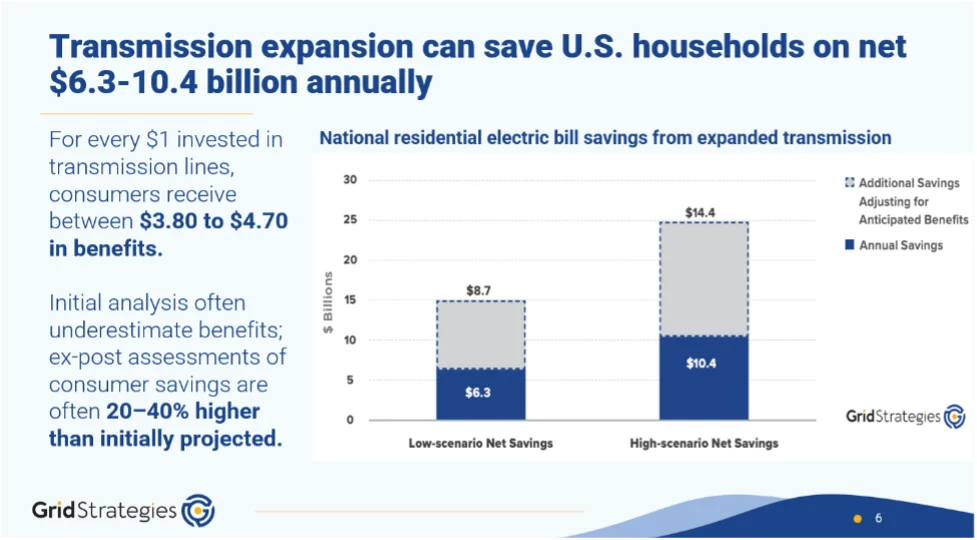
Zach: A transmission portfolio that’s well-planned adds about 1% in terms of the transmission component of your bill — roughly a dollar a month. Generation is approximately 60% of your electric bill, and a well-planned transmission portfolio can reduce that generation portion by about six percent. So you add maybe a little a month in transmission costs but can reduce your bill by well more than that. Really significant savings compared to a scenario where you’re building less transmission and are forced to build out a lot more generation.
Q: What does transmission have to do with jobs and economic development?
Rob: Electricity is such a critical input to almost every business these days. Back when any of us were born, you would have three-day outages — people were just used to it, businesses could operate. But no more. People really depend on reliable power now. So many manufacturers and job creators are looking to make sure they’ve got low-cost, reliable power. And that really begins with good, strong grids.
Q: West Virginia wants to export power beyond its borders. What are the benefits of that?
Rob: You’d be interested in the economic development that comes with it, the jobs, both construction and operation of the power plants, as well as the transmission. All of those have tax bases, the generation plant and the transmission lines generate tax revenue for local communities.
Zach: It is important to have the transmission to export that generation to really get the value out of those investments. During Winter Storm Fern in January, a lot of the gas production in the Marcellus region was not able to deliver its energy to the markets that needed it most. Those extreme weather events are one of the highest-value time periods for a generator — that’s when you can provide the most value to the system overall. It’s one thing to focus on building a lot of generation, but you still need to make sure the power is able to get where it needs to go.
Q: Can high-voltage transmission lines be buried?
Rob: Undergrounding is very expensive. Traditionally about a 10-fold cost increase. I don’t know of any buried 765 kV lines. When you deliver a lot of power, it heats up. Overhead lines have a natural cooling mechanism.